Sunday, July 17, 2016

17 July 2016

Day in Bergamo

Saturday before yesterday we went to a baptism and met Carlo Mongiovi, who was my companion in Bergamo 50 years ago.  Yesterday, our p-day, we drove the hour north-east to Bergamo.  I recognized some of the landmarks in the "new" parts of the city of about 115,223 population. The alps start just north of town, where there is the famous water bottler San Pelegrino, sold all over the world. We easily found a parking garage and walked a few blocks to the funicolare, which is a little tram that goes up steep hills.  We rode up to the Cità Alta (high city).  We walked further up a few blocks to the piazza near the duomo and town hall. Everywhere you go in Italy you walk a lot, and some of the streets are steep, although they sometimes have stairs, and were definitely not built for cars.

This the old city square, with a biker filling his water jug from the fountain.  All of the water in Italy is potable, unless there is a sign that says it isn't.  However, Italians still buy a lot of bottled water, and it is cheap, like less than 20 US cents for 1.5 liters, and they always sell it "naturale" and "frizzante", the latter being fizzy with carbonation, either natural or artificial.  Notice the winged lion of St Mark in the upper left in the pix. It is the symbol of Venice, because Venice ruled this part of Italy a long time ago.

This is the city hall with its bell tower.  Italians love bells and they always chime on the hour and half, and sometimes 15 minutes, and church bells ring for everything, including masses, weddings, funerals, etc.

The first thing we saw on the other side past the town hall is the ancient 8 sided baptistry, obviously built for immersion baptisms.  To the left in this picture is a very large basillica, which is a type of church, and to the left of the basillica is the city's duomo.  Yes, two very large churches side by side, with the duomo being newer (1500s) and smaller than the basillica.


Myrna by one of two red marble lions near the door to the basillica.  The steps in the back of this picture lead to the duomo, bishop's church, or cathedral.  The two churches are, s you can see, very close to each other, but were built at different times.

I tried to sit on his rump, not an original idea as you can tell from the butt-polished red marble, but I slid off easily.

Inside the larger basillica I immediately headed for the organ.  It is a very large organ, and you can see the pipes behind on either side of the high altar, which was not in use.

As soon as we entered the basillica we could hear, very well amplified, the mass going on in a side chapel.  It was the Saturday 11 am mass, and about 6 people were in attendance.  On Sundays and holidays they use the high altar between the two sets of organ pipes, and use the organ.  There were also tourists milling around the basillica, like we were, oblivious to the mass being said.

This is the spot from which I took the picture of the priest in the picture above, I just came in close with my telephoto lens as to not bother the worshipers, You can see how large the church is by looking up.

If you go to the middle of the church and look up you see the ceiling, the inside of the dome. We have been in a lot of churches in Italy, thus far, but Myrna remarked this the most ornate we have been in so far.

On one of the side walls there is a fresco of the Last Supper, painted about 200 years before Leonardo was born and painted his most famous picture of it.  I know the date this one was painted because of a sign, in Latin, by the frescos:.

The date is MCCCXLVII, or 1347, if my Roman numeral reading is correct in this Latin sign.  Reading Roman numerals comes in handy in Italy as they still use them a lot.

There are also a lot of tapestries on the walls in this basillica.  They were made in Italy, although the most famous tapestries were made during middle ages in Belgium.  In the middle of the pix is a large wooden music stand, the music was hand written large enough for the singers to read, since they weren't printing it in those days.

There were some of the most ornate confessionals I have ever seen, of carved wood, with a tapestry behind.

I zoomed in on this depiction, above the confessional, of the circumcision of Jesus.  Notice the size of the knife and expression on Jesus' face.  No wonder Italians don't circumcise.

There was this nice Adam and Even with the snake, in which they are more clothed than usual; maybe they didn't read the part about fig leaves. The fig tree in the public park by where we live has figs, and I test them frequently, so I can pick some when they are ripe.

And this crucifix with a Jesus, obviously from the middle ages.

In the middle is the same crucifix as above, but you can see it in context, with the two sets of organs (actually two separate organs co-joined by the fairly new console) on the sides. Below this is the "high" altar, used for more important masses. Now we leave the Basillica and go to the duomo next door.  This is the area where the high altar is in that impressive church.

The canopy signifies that the bishop sits under it when he is enthroned.  There are two preaching pulpits in this church, accessible by the stairs.  This is a Baroque era church, with large impressive paintings, and no fresco work.

In front of the old high altar (where the priest's back is to the congregation, as it was in the bascillica when he was saying mass) is this more modern altar with some saints bones in the silver bone box under the altar.

And within a side altar (notice the marble work in the floor) was a cute very small pipe organ, where in many churhes is an old pump organ.  Obviously these Bergamosci are pretty sophisticated, or rich to have a little pipe organ to give pitch to the signing.

This is the relatively modern looking basement under the duomo, where some bishops are buried.

There was this sign, in the duomo, listing all of the bishops of this church, starting with S. Narno, from the 3rd century, with the second, Saint Viatore who served from 343 to 344, with a few gaps here and then. We have seen these signs in many duomos in Italy.

Back outside this is the front of the basillica with its two doors, but to one church.

And with all of this old stuff on the walls was a new sign, in glass not to hide the old work,  that says, loosely translated, "where ever there are Christians one must find an oasis of mercy in the desert of indifference" by the current pope, Francis.  We then went to a museum, literally under the new duomo.  It was made only about 25 years ago after they had excavated the old Roman ruins below the duomo.  They had used some of the old Roman stones to build these new churches, and other things in the city.

The signs were in Italian and English below.

An old Roman burial box.

An old Roman high heeled shoe, although they also wore sandals.

Fertility gods from before the time of Christ

Rings and a blade of a sword

Spurs, look sort of like the kind dad wore, not much has changed in 2000 years in the spur world.

Pottery, glassware and coins, all found down under the duomo during excavation.

The old Roman floors were pretty fancy too.

The streets in Cità Alta are all pretty narrow, although there were a few cars and everyone had to get out of the way when they came down the streets.
 

There are uniformed policemen, and they are friendly and helpful, for the most part.

We walked past an open door to the backside of a basement bakery, and saw a baker.  You can see a large mixer in operation and many sacks of flour and ingredients for the many kinds of bread and pastries he was making, in front of him. It was pretty hot down there, which is probably why the door was open.


But we also walked past scenes like this, between old homes with beautiful, peaceful garden areas.

We went in several more churches.  In this one they were having a festa for a saint and there were quite a few people milling around.  They normally don't have the blue curtain, only on her day.

Near one of the exits of the old walled city was another clock and bell tower.  This was near the ancient university.

Going out the gate you can see the old walls of the city below.

On our way back to the funiculare we were hungry, so we stopped by a shop that sold french fries (only french fries), which were hand cut and fried and sold in a cone and eaten with a wooden spear. They put different sauces on the top, and were the best we have have, so far, in Italy.


But after a few more blocks  of walking we were still a little hungry, and decided we needed to eat polenta (corn meal mush) in the city famous for it. So we stopped by a little shop and had one bowl, which we split.  Myrna was not too excited.  Actually they put the polenta in the bottom of the bowl and some pasta sugo (not chili beans, which would have been good), on top. Myrna commented it wasn't as bad as she feared.  We sat next to a random couple (him in the back of both pix).

They were also eating polenta.  She noticed Myrna's name tag and addressed her as Sorella (Sister) Hoopes and said she is also a sorella, then said she has been a member of the church for 20 years and the man was being baptized that very evening.  So we had a pleasant polenta experience with them. She said they now have two large wards and a branch in Bergamo, where 50 years ago, we only had one grandma, Nonna. In fact, this woman even knew who Nonna was, and that she had died about the time she was baptized.  Small world!

We rode down the funicular, and you can sort of see the sprawling new city through the glass.  We left Bergamo and went to a very large shopping mall. I bought a new white shirt and Myrna bought a blouse.

It was another wonderful day in sunny Italy, and it wasn't even too hot.


Monday, July 11, 2016

Meeting old companion

Monday, 11 July 2016

I started this blog yesterday evening, but when I tried to add the pix it killed the site, so I am trying again today. Yesterday was a typical Sunday.  We went to church and came home and ate some minestrone soup Myrna started on Saturday evening.  It was wonderful with the artisan bread we bought in Piacenza.  Then I took a nap while Myrna came down and watched a session of conference in our air conditioned office.  I came down and our new mission president, President Allen, called me and asked if we want to go with them to a baptism in Muggiò, which is about an hour north of here. I remembered I heard that one of my old mission companions is now the high priest group leader of the ward in Muggiò, so I found a picture of him I took in 1966 on the balcony of our apartment in Bergamo, and we went.

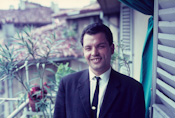
This is the 50 year old pix I found and took to give to Anziano Mongiovi.

 It was a pleasant ride, with our new president learning to use his GPS.  We got there about a half hour early and asked if Bro. Mongiovi (my old companion) would be there.  One of the missionaries called his wife and told her that I wanted to surprise him, so they came, although they hadn't planned on it.

This a pix of the missionaries with the guy being baptized (in the middle). His name is Sonny and he speaks English better than Italian, and has been a refugee (although now legal, we can't baptize illegal refugees) in Italy for about two years.  Myrna records the mission baptisms and many now being baptized are refugees like Sonny, from Africa, where life is indeed terrible.

This is me with my missionary companion of 50 years ago, Carlo Mongiovi.  He was born and raised in Argentina, although his parents immigrated from southern Italy.  He returned to Argentina after completing his mission in Italy and lived there for three years before immigrating to Italy.  He met and married an Argentine woman who had served a mission to Spain. She is also of Italian ancestry.  They have one daughter and three grandchildren. We had a great reunion and relived some old memories of when we were together.  Professionally, he was a sarto (tailor) and once he put a new crotch in my suit pants (with a needle and thread, he was very fast and did a wonderful job) because I damaged them riding my bike.  He continued to be a sarto in Italy, but is now retired.


This is a pix, left to right, of Sister Allen, President Allen, my old companion, Fratello Mongiovi, his wife, me and Myrna.

In talking to Fratello Mongiovi we learned he had been on the high council with President Mario Vaira, as stake president, whom my brother Fred baptized, and knows the Viaras quite well.  We decided that next Thursday afternoon, the 21st (if it is okay with the Viaras), Myrna and I will go pick up the Mongiovis and then go to visit President and Sister Viara, who are still alive and mostly well and don't live very far from Muggiò.  More pix to come.

Saturday, July 9, 2016

Saturday, 9 July 2016

Today was our P-day. However, we drove down to Piacenza to check out an apartment being vacated by the two missionaries this next week.  One is going home after his two years and the other is coming to the office.  Their apartment was very clean and we didn't need to do anything.  They said that they had checked out the other missionary apartment in Piacenza, and the sisters who left it vacant, had done a good job cleaning, and we believed them because theirs was so clean.  So we then drove around the walls of the ancient city and found an entry point and went directly to the train station so I could re-live memories from 50 years ago.

So 50 years ago, by myself, as a new senior companion, called trainers today, I arrived on the train at Piacenza from Torino, scared and also excited to be a missionary on my own, with a "greenie." As far as I know, I was the first LDS missionary ever to be called to serve in Piacenza, and actually served there, with three different junior companions.

This is the train station today, and I think it looked about the same, except there is now a bar-restaurant concession on the right side, where 50 years ago it was a trattoria, or home-style restaurant, run by the wife of the station manager, whose family lived above.  I have previously told the story of the miracle that occurred that day, so I will only briefly mention it here.  I knew I needed to find an apartment to move into that same day, because I did not have enough money for a hotel (even though perhaps my greenie might, they always have money).  I hung out at the train station until lunch time, asking everyone coming and going if they new of apartments for rent, and ate at the tratorria (fixed price for whatever lunch food the woman made that day, and you could have seconds, it was minestrone soup.)

I crossed the street where the news stands were and bought a local newspaper, hoping to find a want ad about a suitable apartment, but I didn't find one. I also spoke to people coming and going on the street, which was across from the train station and a park.

It is interesting that today this newspaper stand was closed, but the daily newspaper in Piacenza is the Libertà, or liberty.

So this is the park today, just where it was 50 years ago.  I remember the bushes were not as well manicured then, and because in my dire situation, I went behind some, where I didn't think I could be seen, and prayed very hard that I could be helped to find an apartment for me and my new companion, who was coming in at the train station that same evening.

As in most Italian parks, there are statues, but I don't remember this one we saw today.  All I remember is that I could see something that caught my eye by some water.

This is the only body of water in the park today, a pleasant fountain, which I don't remember from 50 years ago.  I only remember some water with a boy with a red shirt playing with a stick in the water.
Inline image 1
And since I had my camera, and had taken a few pictures of flowers (coming from the desert in Arizona, I was still in awe of all the flowers in Italy), I took this picture of the boy, which Kevin found among my slides and scanned and sent me.  Again this pix is exactly 50 years old. The boy was alone and there weren't many other people in the park. (Thinking about it now, I wonder why he wasn't in school or something on a weekday early afternoon.)  I said "ciao" to him and he responded in a friendly manner.  I then told him I desperately needed needed to find an apartment to move into that day, Without any hesitation he told me that his grandfather (nonno) had apartments for rent and I should follow him and he would take me to his nonno, which we did.  I remember it was quite a ways away (I had left my baggage at the train station because I knew had to go back that evening to pick up my companion), but we found nonno and he had several apartments in one neighborhood (I am trying to remember where), and I found one that would work well for us.  Trusting me, nonno gave me the key with my promise that after my companion came in later that evening we would come by his apartment and pay the deposit and rent, which we did.  Then I was able to pray again, in my new furnished apartment, for the blessing that the Lord gave me that day.  Then I went out and bought some food so we would have something in the apartment.  

Today I prayed again in that same park in Piacenza, across from the train station, that I was able to learn 50 years ago that Heavenly Father heard my prayers and would answer them in a way that I knew with certainty that He is really there and watching out for me as I was trying to do His work.. (I told that story to the missionaries whose apartment we checked earlier today. I also keep a copy of the picture of the boy with the red T-shirt on the bulletin board above my desk.)

Entrance to the park from the other side.

Today they had one cobblestone street next to the park torn up, laying it again.  If you look closely in about the middle you can see two guys out working, on a Saturday in the heat of the day.  Most old streets in downtown Italian cities are of cobblestones, either squared up stones or round ones that look live river rocks.

We parked our car at the train station parking lot (I went in to use the restroom at McDonalds, which is also right there) and asked where the duomo, or cathedral is, and walked several blocks to find it.  Above is it from the back.

We went in the back door of the duomo and saw that in one of the side chapels they were in the middle of Saturday noon mass.  This was taken at the point (from some distance as to not disturb) when the priest held up the host (wafer of bread) declaring it to be the actual body of Christ (through the incorrect doctrine of transubstantiation). I like to see Italian churches and have seen many in my day, but I don't ever remember going into this duomo before.

Towards the back of the duomo is a plaque showing the names and dates the many bishops of Piacenza served.  The heading says, in Latin, chronology of the bishops of the holy church of Piacenza. You may not be able read, unless you enlarge it, that the first one listed was Saint Victor, who served from the year 322 AD, for 53 years (the first three have been made saints and I suspect their remains are within the church).

And the current (or at least last on the list) is Anthony Mazza (wonder if he is related to the Mazzas in Soda Springs?)

We exited the duomo from the front side door and found they were having a Saturday market in the piazza in front of the duomo.  It was hot and muggy, but there were a lot of people there today.


Here's the front of the duomo showing the market stalls.

I bought a 6 pack of cotton with lycra black dress socks for €6 ($6.63 US dollars), and a new brown belt, to wear with my khaki pants, which I was wearing, for €3.  The sellers were Chinese (there are now a lot in Italy, I didn't see any 50 years ago).  I couldn't find a brown belt that fit within their pile, either too small or too large, so I took off my black belt and her husband very quickly cut a brown belt, using mine as a template, and punched new holes (he even had a leather hole punch), and it works just fine,  In this pix he was actually working on my belt, but it does not show much.  These market vendors sell cheap Chinese (or foreign made stuff).  Italian stuff is much more expensive and better quality, but I didn't need any better today.


I tried not to be too obnoxious when I took this pix, but the lady in the front has dyed her hair bright red (not hair red, but hot pink red), which actually isn't uncommon, even for older women, in Italy.  We also passed by a little naturally red headed Italian boy that reminded me of Mark's Peter.  Italians don't all have dark hair.

This white haired Italian lady, as I have written about before, is typical of women her age who dress up every day to go buy her groceries, which she carries home in the little cart. On the way home we stopped by a large shopping center, so I could use the restroom and we could buy some lunch at the supermarket we saw the sign for.

This is a door to a toilet stall in the men's restroom at the mall.  The mall was decorated in large color pix of Piacenza. This is the Roman wall we had to find a road to go through to enter the center of the ancient city today.

The sign above this hand drier says insert your hands and rub them and they will be dry in 10 seconds, then in finer print below talks about saving energy, and that cold air uses 80% less energy than hot.

Then, above the hand washing sink is a sign that says they treat you with white gloves, and in fine print that they clean more times a day, and thank you for helping keep it clean.  In terms of modernity, in the mirror, you can see the white radiator to keep the room warm in the winter--they still use radiators with hot water to heat rooms in Italy.

I told Myrna that in the good old days, 50 years ago, for lunch, we stopped at a bakery and bought a roll, which the baker sliced for us, then went to the salami shop and the clerk put some nice (thinly sliced) salami or ham on it, then we went to the cheese shop and another clerk sliced us a nice piece of cheese, and we ate our panino (what Italians call sandwiches like this), as we were walking down the street, or we would stop at a park bench or someplace handy.  So today, we were hungry and it was hot outside, so at the mall we went to a large supermarket at the air conditioned shopping center and bought a couple of fresh cibata rolls (about 35 cents), a package of sliced ham (1.59) and a package of sliced emmental (Swiss, with holes, still my favorite) for €1, a kilo pack of grape size tomatoes (certainly couldn't eat them all), and some Sicilian cookies, with carrot and lemon, which looked better than they tasted, as do most Italian pastries.

So on the way back to the car, with our sacks of groceries, I stopped and sat on the bench near the place where kids can play and took out my little Swiss Army knife, cut our rolls down the middle and inserted the ham and cheese and then preceded to eat our panini there in the air conditioned mall, in a place that wasn't all that busy.  Of course, Myrna was moritified, saying that certainly Italians don't do that sort of uncultured thing in public. I remarked I was sorry but it was hot outside and I didn't know where a shady park was from there and didn't want to eat in the car. So we had lunch, on the left side of the above bench.  But as we were about to leave a young couple, who had been to the same supermarket, came and sat on the seat behind us, took stuff out of their grocery cart and made their lunch and ate it as we had done.  Myrna's only comment was "you win."

Instead of taking the freeway home, we told our GPS to avoid the freeways and take us on the little country roads. So she did, and Myrna took this one as I was driving north to Opera, about an hour. There is corn growing on the left (I did see a harvester in action and assume some of it is ripe)  and, as you can see, many country roads have trees planted along the sides. I have seen pix like this of a guy riding a bike with a long baguette (French bread, but Italians make wonderful ones too), but ours was in the back seat.  We had a very nice Saturday again in Italy today.

Ciao for now.